I’ve been working on a longish blog post about the different ways that Jews and non-Jews use a certain word, but it’s been very slow going (a blog slog, as it were). Then a news story came over the transom (thanks to my friend — and sometime commenter on this blog — JIm Laffan) and I just couldn’t resist writing about it. In fact, like those TV shows where characters crossover (Detective John Munch from Homicide: Life on the Street appearing on The X-Files or Murphy Brown appearing on Seinfeld), I will address that story in both of my blogs.
Last Friday (April 30th) Oprah was promoting a national “No Phone Zone Day,” holding rallies across the U.S. to encourage people to put down their mobile phones while driving and keep their focus on the road. That’s all well and good Ms. Winfrey, but I think you’re overlooking what may be the most dangerous form of distracted driving ever:
FHP: Driver Lacked Razor-Sharp Focus
By Adam Linhardt (Citizen Staff)
As authorities nationwide warn motorists of the dangers of driving while texting, Florida Keys law enforcement officers add a new caution: Don’t try to shave your privates, either.
Florida Highway Patrol troopers say a two-vehicle crash Tuesday at Mile Marker 21 on Cudjoe Key was caused by a 37-year-old woman driver who was shaving her “bikini area” while her ex-husband took the wheel from the passenger seat.
“She said she was meeting her boyfriend in Key West and wanted to be ready for the visit,” Trooper Gary Dunick said. “If I wasn’t there, I wouldn’t have believed it. About 10 years ago I stopped a guy in the exact same spot… who had three or four syringes sticking out of his arm. It was just surreal and I thought, ‘Nothing will ever beat this.’ Well, this takes it.”
If that weren’t enough, Megan Mariah Barnes was not supposed to be driving and her 1995 Ford Thunderbird was not supposed to be on the road.
The day before the wreck, Barnes was convicted in an Upper Keys court of DUI with a prior and driving with a suspended license, said Monroe County Assistant State Attorney Colleen Dunne. Barnes was ordered to impound her car, and her driver’s license was revoked for five years, after which time she must have a Breathalyzer ignition interlock device on any vehicle she drives, Dunne said. Barnes also was sentenced to nine months’ probation.
Barnes and Charles Judy were southbound in her Thunderbird at 11 a.m. when they slammed into the back of a 2006 Chevrolet pickup driven by David Schoff of Palm Bay. His passengers were a man and two women; the latter were treated for minor injuries at Lower Keys Medical Center, FHP spokesman Alex Annunziato said.
Schoff had slowed to about 5 mph to make a turn when the Thunderbird hit him, traveling about 45 mph, which was within the speed limit, Dunick said.
Barnes allegedly drove another half-mile, then switched seats with Judy, who allegedly claimed to be driving, Annunziato said.
“She jumps in the back seat and he moves over,” Dunick said. “It was like the old comedy bit, ‘Who’s on first?’ ”
Burns on Judy’s chest from the passenger-side airbag deploying belied their story, Dunick said. The airbag in the steering wheel did not deploy, he said.
Troopers charged Barnes with driving with a revoked license, reckless driving, leaving the scene of a wreck with injuries and driving with no insurance. Judy was not charged.
Barnes faces a maximum of a year in jail if found guilty of violating her probation due to the wreck, Dunne said.
“My phone has been ringing off the hook all day, and I know there’s a funny side to this, but it’s also deadly serious. This is a scary road and a lot of bad wrecks are caused by dumb stuff like this,” Dunick said. “It is unbelievable. I’m really starting to believe this stuff only happens in the Keys.”1
Boy howdy… where do I begin?
- Her ex-husband was riding with her on the way to meet her boyfriend! Well, that was certainly quite open-minded of him — in fact, it reminds me of that old saw “The problem with being open-minded is that your brains might fall out.”2
- Her ex-husband’s name was Judy (okay, it was his last name… but come on, it’s still weird).
- Re: “Ready for the visit” — a euphemism is born!
- Re: The old comedy bit “Who’s on first?” — you know, I always forget… was it Bud Abbott or Lou Costello who was shaving his nutsack in that routine?
Miami journalists quickly picked up on this story and dubbed Megan Mariah Barnes “Pubic Enemy #1.” They also got ahold of her mug shot from the Monroe County Sheriff’s Office.3

Wow… check out those roots! You’ve truly got to wonder about Megan’s hair care priorities.
And — speaking of “roots” — inspired by this news story, the post on my music blog, DJ MJD’s Back Tracks, features the old blues song “Shave ‘Em Dry” by Lucille Bogan.
http://djmjd.wordpress.com/2010/05/03/%e2%80%9cshave-%e2%80%98em-dry%e2%80%9d-%e2%80%94-lucille-bogan/
Be warned though, this lady really put the “blue” in blues!
So… what have we learned?
- You never know where inspiration will come from… sometimes you have to scrape every crevice and other times it just falls into your lap.
I just thought of something… if you follow the dictum that “the drapes should match the carpet,” maybe Ms. Barnes should try out this look:4

Alas, if only Helmut Newton were still alive to truly do the woman justice.
Later…
- From the March 5th edition of KeysNews.com http://keysnews.com/node/21349
- I discussed this saying in an August, 2009 post https://thedornblog.wordpress.com/2009/08/20/high-school-senior-moment-%e2%80%93-essay-tease-vs-acid-test/
- http://blogs.miaminewtimes.com/riptide/2010/03/pubic_enemy_megan_barns_caused.php
- Mega-props to Nate Laffan for his Photoshop magic.
Filed under: Humorous Musings | 1 Comment
Tags: comedy, distracted driving, humor, m. j. dorn, Megan Mariah Barnes, Open-Minded, Oprah, pubic hair, shaving
Happy Passover and/or Easter and/or (my personal favorite) April Fool’s Day!
I am working on my next post which, apropos of being half-Jewish/half-Christian (and 100% non-observant, Agnostic, lapsed vegetarian — but those are stories for other posts), deals with the different ways that Jews and Christians use a certain word.
In the meantime, please check out my new music-oriented blog DJ MJD’s Back Tracks. http://djmjd.wordpress.com/
Back in the day (and the particular day I’m remembering must have been in 1987), I used to make elaborate mix cassettes, cross-fading dialog from my VHS copy of Apocalypse Now with tracks from phonograph records by Echo & the Bunnymen, Robbie Robertson and Los Lobos (and let’s not forget Warren Zevon’s Sentimental Hygiene album). It was tricky back then, you had to drop the needle into the groove just before the song started and hit the record button at the same time — and getting all those levels correct was a pain too. Now, with digital recording, it’s incredibly easy— nevertheless, I’ll just be posting one song a week.
So… what have we learned?
- As technology improves, people get lazier (or at least one person — me).

Enjoy the surreal song by The Alpha Band.
Later…
Filed under: Humorous Musings | 2 Comments
Tags: April Fool's Day, DJ, Easter, humor, m. j. dorn, Michael Dorn, mix tape, Passover, recording, rock and roll
3KRAEQSK9W2Z
[Yeah, I know… sorry about the 2 month gap between posts. No excuses… just took a break. Anyway, I’m back.]
Oh, those wacky Germans – they sure do have a knack for inventing words. Consider these fine examples:
- Blitzkrieg – A swift, sudden military offensive, usually by combined air and land forces [Blitz, lightning + Krieg, war].
- Weltschmertz – Sorrow or sadness over the evils or woes of the world in general; sentimental pessimism [Welt, world + Schmertz, pain].
While those words provide plenty of fodder for cultural stereotyping, let’s not forget another classic:
- Schadenfreude – Pleasure derived from the misfortunes of others [Schaden, damage + Freude, joy].
One certainly could speculate about why the Germans felt the need to coin a word for that particular sentiment.
Today, however, I’m going to focus on a far lighter topic: the Teutonic neologism sitzpinkler. A sitzpinkler is a wussy, literally one who pisses sitting down [Sitzen, to sit + Pinkeln, to pee]. As an insult, it’s not bad (better than “Girlie Man,” in the same genre) and, having both “z” and “k” in it, it’s also fun to say.
If you do an Internet search on sitzpinkler, you might get the impression that, besides being an insult, it’s a movement. Allegedly, groups of women in Germany and some other Western European countries are trying to make it illegal for men to urinate standing up. And, like any movement worth its salt, it even has a manifesto: Das Sitzpinkel Manifest. Hier sitzt Mann.

To top it off, there is even an organization called Mothers Against Peeing Standing Up.1
Several ditto-head bloggers with an anti-feminist and/or anti-European agenda have offered these items as further “proof” that the nanny state is creeping in to emasculate us.
While it makes for an amusing talking point, it really just indicates that their irony detectors are on the fritz. The “manifesto” (currently out of print) was written by a man. The Mothers Against Peeing Standing Up website is half satire and half merchandise catalog – note, for example, the banner ad for the FastSize Extender “male enhancement device” accompanying the following blurb:
“Since we at MAPSU are ‘pee-in-our-pants liberals,’ we do recommend lengthening your phallus as a form of HARM REDUCTION, since a longer penis means urine has less distance to travel, and less distance to travel is a very, very good thing. Furthermore, a longer barrel means increased accuracy; Charlton Heston can attest to that!”2
So, let’s get real: There is little evidence that anyone is actually trying to outlaw the practice – the example usually cited is a situation in 2006 when the female principal of the Dvergsnes School in Kristiansand Norway attempted to ban boys from peeing standing up. A conservative Norwegian politician named Vidar Kleppe protested this, saying:
“If boys are not allowed to pee in the natural way that they have done for generations, then it amounts to an assault on God’s creations.”3
Rather overblown rhetoric, I’d say. People like to pontificate about what’s “natural” but it’s really a bullshit term – poison oak and crab lice are natural. And, how natural is indoor plumbing?
Nevertheless, I will admit I’d assumed that “men stand, women sit” was, to use Kleppe’s phrase “the natural way.” But, according to the Wikipedia article on Urination4 (I kid you not, there’s really is one), this is not entirely accurate:
“Because of the flexible and protruding nature of the penis, it is simple to control the direction of the urine stream. This makes it easy to urinate while standing; most males urinate this way. …Some men also urinate sitting down, especially if defecation has to be done at the same time.” [That’s taking multi-tasking too far, if you ask me.]
“In females, the urethra opens straight into the vulva. Because of this, the urine does not exit at a distance from the body and is therefore hard to control. Hence, urination will normally have to take place while sitting down. …It is also possible for many females to urinate standing while spreading their legs. This technique is not uncommon for a female who wears a sarong, skirt or other such open-bottomed garments, and either wears no underwear, or removes it. …There are reports that seem to indicate that in Togo women urinate using this method, while men do it squatting. Herodotus described a similar custom in ancient Egypt.” [Note that Herodotus has been called both “the father of History” and “the father of lies”5.]
“Though uncommon, it is also possible for females to urinate standing up, in a way similar to that of males. This may be done by spreading the labia minora open and orienting the pelvis at an angle, and rapidly forcing the urine stream out. …Reports indicate that it is common that women in the Ivory Coast use this method when they urinate.” [Question to Susan Wolf and Martha Wolf, who traveled with Robin and me in Italy and also spent several weeks in the Ivory Coast – you told me about the Côte d’Ivoire pastry that looked like a photocopied pudendum; how come you never told me about this?]
“…An alternative method for women to urinate standing is to use a tool known as a Female Urination Device (FUD) to assist.”
Ah, yes – the FUD. I’d wecently, I mean recently, heard about the FUD. On the February 26th episode of Real Time with Bill Maher, the New Rules segment began:
“New Rule: This better not be a device that allows women to pee standing up.”

“Okay, it is, and it’s called the ‘Go Girl.’6 The manufacturers say it’s much more sanitary than sitting on a public toilet seat, unless you consider the fact that you’re walking around with a piss-soaked funnel.”7
Well, just like Herodotus, I seem to have digressed – so, let’s get back to sitzpinkler. European women may not be crusading to criminalize standing urination, but apparently they are trying to shame men into sitting down, using a gadget called S.P.U.K. or WC-Geist.

Kind of cute, isn’t it?
The aggrieved hausfrau attaches this contraption to the underside of the toilet seat.

When the device detects that someone has lifted the seat, it plays a recorded warning/threat which, according to the ad, is so loud that people in neighboring rooms can hear it. The installer can select from 8 different messages, including 1 in English. To hear them, go to http://www.media7trade.de/16.html?&tx_ttnews[tt_news]=5&no_cache=1.
Enough about the Germans – I’m aware of 2 instances in the last decade when the issue of men sitting down to pee was addressed in American popular culture.
- About Schmidt – In this 2002 film, Jack Nicholson played Warren Schmidt, a retired insurance company actuary whose wife, Helen, insisted that he sit when he urinated (probably not a coincidence that he had a German last name). After her death, Schmidt experiences a moment of liberation by standing up and pissing on the toilet seat.
- Curb Your Enthusiasm – In the episode from Season 4 entitled “The Weatherman,” Larry David takes the eternal male-female feud over leaving the toilet seat up and cleverly turns it on its head.
First, in a conversation with his father Nat (played by comedian Shelley Berman), Larry reveals his predilection.
Larry: “Hey Pop, do me a favor, okay? Next time you use the bathroom, make sure to keep the seat down.”
Nat: “What’re you, pussy whipped?”
Larry: “It’s not really about her, it’s about me. I pee sitting down.”
Nat: “How long you been doin’ that?”
Larry: “Well, it started because I was getting up to go at night sometimes and, and I didn’t feel like putting the light on. So I would sit down and then I figured – y’know, I got very comfortable with it. I, uh, like…”
Nat: “Comfortable with it? A man doesn’t do that. A man stands up to pee.”
Larry: “I like to sit down – and I don’t want to wind up in the toilet because you’re keeping the seat up. Keep the seat down.”
Nat: “No, you stand like a person… I’m, I’m very upset with this. This is crazy!”
Larry: “You know what Winston Churchill said? ‘Why stand when you can sit?’ Have you ever heard that expression?”
Nat: “No, I never heard that expression, but I don’t think he meant the toilet.”
That evening, after eating dinner at his manager’s house, Larry’s wife Cheryl feels nauseous; she goes into the bathroom and tries to make herself throw up. Later that night, Larry wakes up and goes into the bathroom to pee. In the dark he sits down and falls into the toilet – Cheryl had left the seat up. Larry, in true sitzpinkler fashion, kvetches to his wife: “Awww… y’ gotta keep the seat down, Cheryl. Not too much to ask, to keep a seat down. Soakin’ wet… hurt my back… soakin’ wet… awww!” [A perfect reversal of the classic argument]
The next day, when he goes over to see Jeff Greene, his manager, Larry is walking with a cane.
Jeff: “What happened to you?”
Larry: “I fell in the toilet.”
Jeff: “How d’you fall in the toilet?”
Larry: “I went to go pee and the seat was up.”
Jeff: “What does that have to do with you?”
Larry: “I pee sitting down.”
Jeff: “You pee sitting down?”
Larry: “Yeah, have you ever tried it?”
Jeff: “No!”
Larry: “It’s more comfortable, when you get up during the night you don’t have to turn the light on and wake up, and you get to read.”
Jeff: “What are you reading?”
Larry: “I’m reading a lot of stuff.”
Jeff: “What stuff?”
Larry: “If I pee twenty times a day, I can get through a whole New York Times for God sake!”
Jeff: “Twenty times?”
Larry: “Hey buddy, when you’re peeing all over your shoe, I’m learning something.”
Jeff: “What makes you think I’m peeing all over my shoe while you’re learning something?”
A minute later, their friend Marty Funkhouser joins the conversation.
Marty: “Why do you pee sitting down?”
Larry: “Many reasons.”
Marty: “Do you crap standing up?”8
While this episode is hilarious, I must point out that the argument Larry offers for sitting down is illogical – if he doesn’t turn on the light, then how does he read? Also, Larry David only sits down to piss when it serves his comedic purposes. In Season 7, much of the plot of the episode “The Bare Midriff” revolves around Larry urinating standing up.
So… what have we learned?
- Re: Mother’s Against Peeing Standing Up – One person’s deadpan satire is another person’s sign of the apocalypse. Famously, some readers of Jonathan Swift’s brilliant essay A Modest Proposal express outrage at his apparent suggestion that poor Irish families should ease their economic woes by selling their children as food for rich English lords and ladies.
[Note: Standing urination was a plot device in Swift’s most famous work, Gulliver’s Travels. In Lilliput, where the people were only 6 inches tall, Lemuel Gulliver put out a fire in the Royal Palace by urinating on it – thereby repulsing the ungrateful Empress, who had previously found him charming.] - Re: Larry David’s apparent flip-flop on sitting versus standing. As Ralph Waldo Emerson said, “A foolish consistency is the hobgoblin of little minds.” In this case, it might be the S.P.U.K.

I often speculate about ways that I might make a little money off of this blog. In other media, Product Placement is touted a source of revenue. Well, this post certainly has an oddball assortment of products woven through it. I’ll let you know if any manufacturers contact me.
You Go Girl.
Later…
- http://www.mapsu.org/
- http://mapsu.org/pe.htm
- http://www.theage.com.au/news/world/aimless-youth-embroiled-in-lav-affair/2006/10/15/1160850812221.html
- http://en.wikipedia.org/wiki/Urination
- http://ancienthistory.about.com/od/herodotus/p/Herodotus.htm
- http://www.go-girl.com/
- http://www.hbo.com/real-time-with-bill-maher/episodes/0/174-episode/article/new-rules.html
- http://www.youtube.com/watch?v=kuHDYR9uRGc
Filed under: Humorous Musings, words | 1 Comment
Tags: Bill Maher, comedy, Curb Your Enthusiasm, English Major, German, Go Girl, humor, irony, language, Larry David, m. j. dorn, Michael Dorn, peeing, pissing, S.P.U.K., sitzpinkel, sitzpinkler, urination, urine
In the Winter of ‘65 – Part 2: Once Upon a Time You Dressed So Fine (Because Your Mother Made You)
[To recap: This is the story of my first rock concert and the meshugaas that preceded it. In Part 1, I argued with my parents – I wanted to go to Berkeley with 3 friends to see Bob Dylan perform, but they said no. The resolution: One of my friends’ parents would drive us to the concert, but I would have to wear a jacket and tie. The evening before the show, as a sort of hors d’oeuvre, I watched a televised Dylan press conference that included several of my journalism classmates asking him questions.]
I don’t think Eloise and Merrold Campbell fully understood the commitment they’d made when they agreed to accompany their son and his friends to this concert.
For one thing, they probably didn’t know exactly where I lived. My home was halfway up a hill in Ross, on a remote byway with a name that managed to sound both awkward and snooty at the same time: Upper Road West. Negotiating its narrow twists and turns for the first time in the dusk of a December evening, I suspect they may have begun to question their decision, as they realized they would have to repeat this odyssey later that night.
Don’t get me wrong – I loved living there! There were beautiful trees (including several Coast Redwoods), deer grazed on the hillside, and the view was spectacular. On a clear day, I could look across the bay and (with binoculars) see the campanile on the UC Berkeley campus – that hotbed of student unrest that was so worrisome to my parents. It was a great place to grow up… just not a particularly convenient one when you needed someone to give you a ride.
I saw the Campbells’ car coming up our driveway, said a curt “Bye” to my parents and headed out the door. An hour before there’d been one last skirmish in the Battle of the Blue Blazer. As with all the others, I’d lost. This squabbling had soured my excitement about the concert; instead of the eager anticipation that I’d felt last night, I was just impatient and crabby.
I walked down to the driveway and got into the back of a new 1966 Caprice (John’s dad owned the local Chevrolet dealership). Like me, John was wearing a sport coat and tie – but somehow he just managed to look “dressed up” in a generic way; I looked (or at least, in my full-blown, adolescent self-consciousness, I felt that I looked) like I was going on a prep school field trip.
I made small talk with John and his parents as we shlepped around Marin to pick up Jerry Carbone and Dave Greenfield. Neither one was wearing a jacket or necktie. I gave each of them a “What the @#$%?” look, but didn’t say a word about it. Hell, I didn’t blame them – I was the shmendrik who couldn’t stand up to his parents. Interestingly, Mrs. Campbell didn’t comment on this apparent dress code violation either – had I been punked by my own mother? This turn of events did not improve my mood.
John and Dave debriefed their experiences at yesterday’s press conference. Most the time I listened passively, but one thing caught my attention – John made a remark about the “wild man” who’d shouted at Dylan, “Do you think there’ll ever be a time when you’ll be hung as a thief?”
Me: “Uh… that was Ginsberg.”
John: “Huh?”
Me: “That guy… y’know, with the beard? That was Allen Ginsberg.”
John: “Uh… yeah, of course.”
John knew a lot more about poetry than I did. More to the point, John had loaned me his copy of Howl – the only Ginsberg poem I’d even read at the time. Still, just for a moment, I wondered: Was it possible that John hadn’t recognized who’d been sitting next to him?
The drive to the East Bay seemed to take forever, but eventually we arrived at the Berkeley Community Theatre and the 4 of us piled out of the car. An usher lead us down the center aisle – all the way down to the 4th row. Our seats were just to the right of the aisle; I hadn’t appreciated how incredibly close we were going to be.
We’d arrived very early and had a lot of time to kill before the show – a typical rookie mistake. I loosened my tie (at the time, I wasn’t good at tying a necktie, even when looking in a mirror – without a mirror, forget about it; that’s why I didn’t take it off). The theater wasn’t very full yet and it was cold so I actually left my blazer on.
The concert was supposed to start at 8 P.M. Of course it didn’t, which fueled my antsiness. About 8:20, I heard a commotion coming from the back of the auditorium. I turned around and saw a group of Hells Angels walking down the aisle past us, carrying folding chairs. They seated themselves in the pit area, right in front of the stage. I wasn’t sure what to make of this. On the one hand, given my cranky frame of mind, I was irked that these “thugs” could just walk in and sit wherever they wanted. On the other hand, it felt pretty wild to be at the same concert as these notorious “outlaw” characters. I wondered if Mr. and Mrs. Campbell had witnessed the Angels’ dramatic entrance.
More time passed. Suddenly, the stage curtain moved slightly and the audience reacted with murmurs of excitement. But the curtain didn’t actually open – instead, three people emerged from behind it, looking rather disoriented… as if they hadn’t quite expected to find themselves standing on a stage in front of several thousand people.
They certainly were an interesting trio: Allen Ginsberg, Peter Orlovsky, and a woman in a fishnet dress. Ginsburg was holding hands with Orlovsky; I had never seen 2 men holding hands before. At the time, I’d also never seen a man with hair as long as Orlovsky’s (it was well below his shoulders). The attractive brunette woman with them was built like a brick shithouse – a fact emphasized by her outfit: A black leotard and black tights covered by a very loosely knit mini-dress (she wasn’t wearing it for warmth, if you catch my drift).
Orlovsky and the woman stood there awkwardly for a couple of minutes, while Ginsberg crouched down and chatted with some people in the pit area. Observing this novel threesome initially was diverting, but soon my impatience returned. When would the damned concert begin?
My resentment was coming to a head. I was pissed off at my parents, pissed off at the Hells Angels, and, ultimately, pissed off at myself for being so pissed off! My frustration was spiraling out of control and, to top it off, there onstage, instead of Dylan, was Allen Ginsberg – shmoozing away as if he were at a kaffeeklatsch.
Like magma striving to erupt through the Earth’s crust, my seething irritation sought out a point of weakness where it could burst through to the surface. The one it found was immaturity.
I cupped my hands around my mouth and blurted out, “Down in front, Ginsberg!”1
John Campbell was absolutely mortified. He immediately shushed me… but he needn’t have bothered. Suddenly, I felt blissfully calm… this moronic act had purged me of all hostility and anxiety.
Ginsberg scanned the audience. He didn’t look upset or offended; he just looked like someone who’d unexpectedly heard his name called. I’ll never know what, if anything, he heard, but immediately after that he and his 2 companions climbed down from the stage and took their seats.
A few minutes later, the house lights dimmed and Dylan walked out onto the stage.2
I probably didn’t know the word at the time, but watching him – one man, alone, with just an acoustic guitar, a harmonica and his distinctive voice – hold 3,400 people transfixed for an hour was an object lesson in charisma. I sat spellbound. He sang a few of the songs from Bringing It All Back Home that I’d listened to on my record player the night before. Now everything about them was more intense, raised to a higher level – it was my first experience of the je ne sais quoi of a live performance by an artist at the top of his game.
In the middle of the set, he introduced a new song, “Seems Like a Freeze Out,” which he’d mentioned in passing at the press conference. This was the first public performance of the song that, when released on Blonde on Blonde, was titled “Visions of Johanna” – and it was breathtaking.
Oh yeah… Dylan wore a sport coat. I recognized the irony, but didn’t give a shit anymore. Hey, he was Bob Dylan – he could wear whatever he wanted (and make it cool).
The first set ended. I wanted to talk with my friends about it, but struggled to find words that adequately expressed what I’d experienced. We got up and slowly made our way towards the lobby. There was another murmur of excitement – Joan Baez had been spotted in the audience. Jerry Carbone pointed her out to me (it looked like her – but in Berkeley in 1965 it wasn’t that hard to find women who looked like Joan Baez). I wondered what she’d thought when Dylan had sung his new song about a mysterious, haunting (and absent) female presence named “Johanna.”
After John checked on his parents, we returned to our seats. Soon the curtain opened, revealing Dylan and his band. He had changed clothes and was wearing a brown hound’s-tooth suit. The pattern was unlike any hound’s-tooth I’d ever seen before; the “tooth” was gigantic… that was one hound you definitely wouldn’t want to mess with! It also didn’t look like any suit my parents would have made me wear.
The band launched into “Tombstone Blues.” Holy shit! I’d never heard anything so loud before in my life. In fact, I’d never experienced anything like it: a tsunami of sound was crashing over me – at its crest, Dylan intoned his hipster jeremiad, stretching and bending syllables like a blacksmith working red-hot iron.
“Welllll, the sweet pretty things are in bed now, of course.
But the city fathers, they are planning to endorse
The reincarnation of Paul Revere’s horse
But the town has no need to be nervous.
The ghost of Belle Starr, she hands down her wits
To Jezebel the nun; she violently knits
A bald wig for Jack the Ripper, who sits
At the head of the chaaamber of com-merce.”3
[There is a bootleg recording of the electric set from this concert. You can listen to 8 of the 9 tracks at
http://www.soundboard.com/sb/Bob_Dylan_Live_Berkeley.aspx
The sound quality is rough, but for a “field recording” from 1965, it’s better than you’d expect. Rumor has it that Ginsberg taped it. He wasn’t carrying a reel-to-reel tape recorder when I saw him before the show, but he could have brought it in at intermission. Famously, when Dylan “went electric,” he was booed by members of the audience who felt he’d “sold out” or some such bullshit. I didn’t hear any booing (although, frankly, I might not have heard a howitzer being fired either) and the recording confirms that. The audience was digging the show!]
The intimacy of the first set had been replaced with raw power. A few of the high points for me included:
- “Baby Let Me Follow You Down” – John Campbell had been right to make us listen to Dylan’s first album. Having heard that lilting blues version of the song, I was blown away by his transformation of it into a full-tilt rocker.
- “It Ain’t Me Babe” – With its smashing power chords and snarling delivery (“Go a-waaay from my win-dow, Leave at your own chosen speeeeed”), this is definitely not The Turtles’ version. Clearly, “your own chosen speed” had better be pretty @#$%ing quick!
- “Ballad of a Thin Man” – Dylan played the piano and sang; Garth Hudson’s organ fills were amazing. I’d always liked the caustic, surrealistic put-downs in this song, but my experiences at this concert revealed to me that I actually was more like the Thin Man – something was happening and I didn’t know what is was – but I damned sure wanted to find out!
The concert ended with “Like a Rolling Stone.” How does it feel? Triumphant! There was no encore (imagine that these days). When we got to the lobby, we met up with John’s parents – they’d been waiting out there for most of the second set. Predictably, they complained about how loud the band was.
My friends and I knew we’d experienced something very special – but it was going to take awhile to absorb it all. We chatted a little during the ride home, but there were also periods of silence. At some point, I realized it was after 11 P.M., so I asked Mr. Campbell to change the radio station to KFRC – I wanted to hear The Jean Shepherd Program. On Saturday nights, he’d broadcast live from the Limelight Cafe in Greenwich Village. I thought this would be a great opportunity to introduce my friends to the show. Unfortunately, Shep began the program doing a lampoon of folksingers. He twanged his trademark jew’s harp, imitating an inept musician who was incapable of tuning his guitar. In another context, the monologue might have been hilarious; that night, it just sank like a waterlogged turd.
When we finally reached my house, I thanked the Campbells for driving and headed inside. My parents were awake but I didn’t feel like talking to them. As soon as I could, I said “good night” and went to my room. I lay on the bed, simultaneously exhausted and exhilarated. I’d been to my first rock concert – and couldn’t wait to go to my next one.
So… what have we learned?
- “Comedy is tragedy plus time” – Although being forced to wear a navy blazer to this concert was merely embarrassing, not tragic, the concept still applies. After 44 years, I finally can appreciate that it gave me a nice hook for this story. Hey Mom, I’m sending “Thank you” vibes out to you, somewhere on the astral plane.
I’ve seen hundreds of concerts since then, including 20 more Dylan shows (most recently at the Hollywood Palladium last October). But, as they say, you never forget your first time.
Later…
- I recognize that this doesn’t put me in the same league as the guy who yelled “Judas” at Dylan during the Manchester Free Trade Hall concert in 1966 or Representative Joe Wilson who screamed “You lie!” at President Obama during his recent health care address to congress. We were all being uptight idiots, but my comment was more of an absurdity than an insult. Ginsberg himself had shouted out that absurdity about being “hung as a thief” at Dylan the previous afternoon – admittedly a wittier comment than mine.
- Unfortunately, I was unable to connect with Larry Keenan to get permission to use his great photographs of the concert in this blog post. Please go to http://www.emptymirrorbooks.com/keenan/b1965-7.html
to check them out and to read his account of that weekend’s events. - Copyright ©1965; renewed 1993 Special Rider Music
Filed under: 60s Flashbacks, Bob Dylan, Humorous Musings | 9 Comments
Tags: 1965, Allen Ginsberg, Berkeley, Bob Dylan, humor, m. j. dorn, memoir, Michael Dorn, rock and roll, The Sixties
In the Winter of ’65 – Part 1: Your Sons and Your Daughters Are Beyond Your Command (or Not)
[To kick off 2010, here is the first half of the long but (I hope) amusing story of my first rock concert and the meshugaas that preceded it.]
Return with us now to those thrilling days of yesteryear – November 1965, about a month before my 16th birthday.
 The Author Circa 1965
My attention had been focused on that great adolescent rite of passage: getting a driver’s license. I envisioned that having a driver’s license would change my life, opening up a world of possibilities that I could scarcely imagine – dating without a parental chaperone, for example. Apparently I thought there was some connection between license and licentiousness – or at least I hoped there was.
I was a junior at Redwood High School in Marin County. California. Instead of taking regular English classes that year, I was in EJ5 and EJ6 – a combination of English and Journalism. The idea was that we’d study journalism as juniors and then put out the school newspaper, the Redwood Bark, as seniors.
A good friend of mine, John Campbell, was also in that class. Earlier in the year, he had somehow finagled to get approval for an official student organization with the rather awkward name “The Modern Poetry in Music Appreciation Society.” It was essentially a ruse to get an Audio-Visual monitor to deliver a phonograph to the EJ classroom once a week, so we could listen to records during lunch. John, however, took the name seriously – after we listened to a song, he would pass out dittoed1 pages of the lyrics and facilitate a discussion of their meaning.
John, as founder of this organization, also exerted total control over the music we listened to – for example, he insisted that we listen to Bob Dylan’s albums in chronological order. He thought that, by taking this approach, we would gain insights into Dylan’s development as an artist. As a result, I got to hear his first album (Bob Dylan) for the first time, including – notably – the song “Baby, Let Me Follow You Down.”
One day in November, John came up to me before class started and told me exciting news: Dylan would be performing at the Berkeley Community Theatre on Friday, December 3rd and Saturday, December 4th. The tickets would go on sale next Saturday.
Naturally, I was eager to go. Two other members of our journalism class, Jerry Carbone (head of the Student News Bureau) and Dave Greenfield (aspiring photo-journalist) wanted to go as well.
Given the rigmarole and cost involved in buying concert tickets nowadays, it’s hard to believe that:
- The tickets cost $4.50.
- When John went to the San Rafael ticket agency on Saturday morning, he was the only person in line.
When I saw John the following Monday, in a numerological fluke, he had 4 tickets in the 4th row for the December 4th show.
I was incredibly excited – it even (temporarily) eclipsed my obsession with preparing for the driver’s license exam. But being able to drive was not irrelevant to this situation: I lived in Marin County (in a town called Ross) and the concert was in Berkeley, 21 miles away. How was I going to get there?
In my naïve attempt to address that simple question, I wound up becoming an inadvertent shit stirrer.
I innocently mentioned to my parents that I had a ticket for a Bob Dylan concert in Berkeley. They didn’t know Dylan from Adam, but they were not happy that I had done this – especially my mother. I was an only child with over-protective parents and, predictably, they told me flat-out that I could not go.
Me: “Why not?”
Them: “You didn’t ask our permission before you bought the ticket.”
Me: “I bought it with my money. I didn’t need to ask your permission before I bought his album.”
Them: “You don’t need to go to Berkeley to listen to the record.”
It was late 1965. To my Republican parents, Berkeley conjured up images of rioting college students – the Free Speech Movement, Vietnam War protests, etc. It didn’t matter that I wasn’t going to the UC Berkeley campus – in their minds, the whole town was some sort of left-wing cesspool.
I tried a classic teenage argument:
Me: “But… three of my friends are going.”
Them: “Who?”
Me: “John Campbell… and 2 other guys from our English class.”
Them: “You expect us to let you go to Berkeley with 2 boys we don’t even know? Who’s driving?”
Me: “Well, I don’t know yet… maybe John.”
They simply wouldn’t budge… I could not go.
But then – and I’m still not exactly sure how this came about – my mother spoke on the phone with John’s mother. Following that conversation, she informed me that John’s father and mother would accompany the 4 of us to the show.
Me: “They’re going to drive us?”
Them: “Yes.”
Me: “What are they going to do while we’re at the show?”
Them: “John got tickets for them.”
Me: “You’re kidding!”
Them: “No. Unfortunately, John couldn’t get them seats next to you… they’ll be in the back of the theatre.”
“Unfortunately” my ass… I was certain that John didn’t want to sit with his parents during the concert. I was also certain that his parents weren’t exactly thrilled by the prospect of attending the concert… but at least now I was going to be able to go. My mother, however, had one last parental maneuver up her sleeve: later that day I found her in my room, looking into my clothes closet.
Mom: “I’m taking your navy blazer to the dry-cleaners.”
Me: “Why?”
Mom: “You’re going to a concert… you need to wear a jacket and tie.”
Me: “What?”
Mom: “It’s a concert… you’ve got to look presentable.”
Me: “But… it’s not that kind of concert. Nobody will be dressed like that!”
Mom: “Listen, the only reason I’m letting you go is that Mrs. Campbell agreed with me – all of you needed to wear coats and ties!”
I couldn’t believe the humiliation my own mother was inflicting upon me. It was bad enough that I was going to have to wear a @#$%ing blazer and tie to my first rock concert – but she was forcing my friends to do it too. At school the next day, John and Jerry kidded me about it, but Dave – well, he was just pissed off. I didn’t blame him, either.
Despite all the nonsense, I was really getting excited about going to my first rock concert. Then, a few days before the show, something totally unexpected happened. Our journalism teacher, Miss Gentry, informed John that Dylan was going to have a press conference on Friday, December 3rd and several Bay Area high schools, including Redwood, had been invited to send student reporters. She’d selected John to go. Somehow, John convinced Miss Gentry that he needed a photographer to go with him, so Dave went along too. I was amazed (and jealous) when I found out. And, even though I couldn’t attend the press conference in person, it was going to be broadcast on KQED, the local public television station, that evening, so I would be able to watch it.
That Friday afternoon I commandeered the TV set. I tried to explain to my mom about the press conference – she just asked why Miss Gentry hadn’t selected me to go. I pointed out that I didn’t have a driver’s license yet and went back to fiddling with the “rabbit ears” antennae to improve the reception.
As soon as the press conference began, I saw Dave Greenfield with his camera, sitting cross-legged right up front [he’s just below the word “press”].2

When Dylan came on, my mother looked over at the TV. “See, he’s wearing a sport coat.” she said.

Bob was, indeed, wearing a tweed sport coat. Damn! Any chance that I could avoid having to wear my blazer to the concert went right out the window. Well, at least he wasn’t wearing a tie – but then again, I didn’t own any shirts with a pin collar like his.
I sat enthralled, watching Dylan field a slew of ultra-serious questions with hilarious put-on and/or put-down answers. As the press conference continued, Dave snapped pictures and John, seated between Michael McClure and Allen Ginsberg, fidgeted nervously.3
 John Campbell Between 2 Beats
Suddenly, I was shocked to see another student from my journalism class there among the reporters – a girl named Michelle Basil.

Geez… this was starting to get surreal. I hadn’t seen so many of my classmates on TV since my cub scout troop went to a taping of King Norman’s Kingdom of Toys. I wondered how Michelle had gotten into the press conference.4 Although we were both in the EJ classes, I didn’t know her very well. I regarded her as Redwood High School’s preeminent Beatlemaniac – which was probably true, as far as it went. In fact, I once heard a disc jockey on KYA (a Bay Area radio station) say that he had just checked with Michelle Basil to get the facts regarding some Beatle-related rumor. On the other hand, God only knows what impression she had of me – some hybrid of nerd and class clown would be a reasonable guess.
A little later, as I watched dumbfounded, Michelle asked Dylan a question.
MB: “Do you prefer songs with a subtle or obvious message?”
BD: “With a what?”
MB: “A subtle or obvious message?”
BD: “Uh… I don’t really prefer those kinds of songs at all – ‘message’ – you mean like.. what songs with a message?”
MB: “Well, like ‘Eve of Destruction’ and things like that.”
BD: “Do I prefer that to what?”
MB: “I don’t know, but your songs are supposed to have a subtle message.”
BD: “Subtle message??”
MB: “Well, they’re supposed to.”
BD: “Where’d you hear that?”
MB: “In a movie magazine.”
Everyone in the place laughs (including Dylan).
BD: “Oh… oh God! Well, we won’t… we don’t discuss those things here.”
[It was, as Yogi Berra would say, déjà vu all over again, when – in September 2005 – I encountered this exchange while watching the second night of Martin Scorsese’s documentary “Bob Dylan: No Direction Home” on PBS. Michelle Basil – eternally 16 years old – had become part of the official Dylan hagiography.]
Considering the tone that Dylan had taken with many of the other questioners, he’d been relatively gentle with Ms. Basil.
Eventually, John asked a couple of questions – one about the incident that led Dylan not to perform on The Ed Sullivan Show and then a rather literal one: “Where is Desolation Row?” Dave Greenfield even put down his camera and asked a question. I couldn’t believe it – friends of mine were on television, interviewing Bob Dylan.
There were only about 24 hours to go before the concert. I was so excited I could hardly eat dinner that night. Later, I listened to Bringing It All Back Home on the little portable record player in my bedroom and tried to imagine what tomorrow night would be like. Then I got into in bed and turned on my transistor radio. From 11 PM to midnight, KFRC, an AM radio station in San Francisco that was Top 40 format 23 hours a day, would play Jean Shepherd’s late night monologues from its New York sister station, WOR. There in the dark, listening to Shep’s satirical commentaries and nostalgic tales, I finally drifted off to sleep.
So… what have we learned?
- The times they have a’changed: phonographs, ditto machines, black & white televisions and transistor AM radios are all museum pieces.
- I think we can add “strict parents” to that list, too.
Later… [In the second half of this story, I promise to actually tell you about the concert.]
- Before Xerox and photocopying, the Ditto Machine was a cumbersome means of duplicating documents. The fluid used in the process caused the paper copies to give off intoxicating fumes that students enjoyed inhaling – a very mild precursor to huffing – as shown in a scene in the movie Fast Times at Ridgemont High.
- All of the pictures from the press conference are frame captures from the DVD Dylan Speaks – The Legendary 1965 Press Conference in San Francisco, © 1965, 2006 Jazz Casual Productions, Inc.
- The roster of people at that press conference is remarkable – from concert promoter Bill Graham to members of the improv group “The Committee.” Blair Miller has documented the attendees – check it out at:
http://kripes.proboards.com/index.cgi?board=general&action=display&thread=1 - Demonstrating a combination of savvy and chutzpah, she had written to Albert Grossman (Dylan’s manager) and asked if she could interview Dylan; Grossman wrote back, inviting her to the press conference. Michelle (Basil) McFee recounted her experiences in “Clean-Cut Kid,” a chapter in the book Encounters with Bob Dylan: If You See Him Say Hello and writes the blog The World According to Me http://mizshelysspace.blogspot.com/
Filed under: 60s Flashbacks, Bob Dylan, Humorous Musings | 18 Comments
Tags: 1965, Bob Dylan, humor, KQED, m. j. dorn, memoir, Michael Dorn, Press Conference, Redwood High School, rock and roll, San Francisco, The Sixties
Czar, Czar Away!
[I’m bidding adieu to 2009 in English Major mode.]
Lake Superior State University in Michigan has released its annual List of Words to Be Banished from the Queen’s English for Mis-use, Over-use and General Uselessness.1
While “shovel-ready” topped their list, I was happiest to see their call for banishing all “czars.”
I have always hated this term for a high-level appointee in charge of some (often useless or ineffective) effort. Specifically, I remember back in 1989, when Bush the Elder appointed William J. Bennett as “Drug Czar.” Bennett – a bloated, pompous, right-wing sack of shit who moralized about self-discipline and virtue while losing $8 million gambling – sure solved America’s drug problem, didn’t he?
We have witnessed a veritable czar explosion since then2. Bush the Elder only had 2 czars, Clinton had 7, Bush the Younger had 35 and, by some counts, Obama has 38! “W” gave us such crucial civil servants as the Abstinence Czar and the Reading Czar. Not to be outdone, the Obama administration has appointed a Great Lakes Czar and a Weatherization Czar.
My personal favorite: Bill Clinton had a Czar Czar (honest!)3 – perhaps to determine what the meaning of “is” is.
It’s bad enough that presidents create these questionable bureaucratic positions – but why the Hell would they want to call them “Czars”?
Unless you’re a scholar of Russian history, you can probably only name 3 or 4 czars:
- Ivan the Terrible – need I say more?
- Peter the Great – an empire builder (literally).
- Catherine the Great – (technically a czaritza) she came to power through a coup d’état. NOTE: The story about her dying while having sex with a stallion is an urban legend; but she did have a fatal stroke while sitting on the toilet.4
- Nicholas II – an autocratic anti-Semite who lost a war with Japan, brutally oppressed his people, and eventually was forced to abdicate, thus laying the foundation for the Bolshevik Revolution.
So… are these despotic monarchs really the best role models that we can think of for people appointed to address an issue?
Lastly, there’s the spelling – is it czar or tsar? How about csar? After all, the title, like Kaiser, derives from “Caesar.” Hey, why not tzar? If we’re not even sure how to spell it, it’s not surprising that we’re not sure what these Executive Branch appointees actually do.
So… what have we learned?
- Elvis may have been the King, but he wasn’t the first royal personage rumored to have died on “the throne.”
I’d love to see the term “czar” assassinated in 2010 – but frankly, I think that’s wishful thinking. It’s so entrenched that it’s probably going to be harder to kill than Rasputin.
[Sorry if I morphed from English Major mode to Curmudgeon mode.]
Later… and Happy New Year!
Filed under: Humorous Musings | 7 Comments
Tags: 2009, comedy, czar, English Major, humor, language, m. j. dorn, Michael Dorn, words
Here’s another story about an unusual situation my wife and I encountered while traveling, that happened in part because of Robin’s multiple sclerosis.
About 15 years ago, Robin and I took a vacation in New Mexico. We absolutely loved it. You have to love a state that not only has the roadrunner as its Official State Bird (beep beep!) but also has an Official State Question. That sounds rather metaphysical, but it really isn’t – the question is “Red or green?” which refers to the color of chili that you want with your food. New Mexicans being pretty laissez-faire folks, there is no Official State Answer, but many locals we met suggested “Christmas” (i.e., both sauces).
We used Santa Fe as our base and took side trips to Bandelier National Monument, Taos and Chimayó – beautiful scenery and great food!
Of course, all good things must end – after 8 days we found ourselves at the Albuquerque airport, waiting for our Southwest Airlines flight back to LA. Robin wasn’t in a wheelchair at this time, but she used a quad cane to walk.

When you’re disabled (or flying with someone who is), you get to “pre-board.” George Carlin once asked, “What does it mean to pre-board? Do you get on before you get on?” To compound the linguistic obfuscation, the pre-boarding announcements tend to use vague euphemisms for disability like “those passengers requiring special assistance.” Hey, I’ve got your “special assistance” right here buddy.
Anyway, to make sure we could pre-board easily, we got to the airport ridiculously early… at least by 1994 standards. Post 9/11, everyone has to get there ridiculously early.
Robin and I took the first 2 seats next to the gate entrance and waited. We were talking when I became aware of a large, older man who was slowly approaching the gate. He was about 6 foot 4 and appeared to be Indian – East Indian, not Navajo or Hopi as you’d expect to see in the Albuquerque airport. This gentleman definitely caught my attention – not only was he tall and hefty, he had a long, flowing beard and was wearing a turban and a gleaming white robe. An emerald-cut ruby, about the size of a deck of cards, hung from a gold chain around his neck. He supported himself with a gold-tipped walking stick.
All of that would have made him pretty hard to miss. But he wasn’t traveling alone. Far from it – he had an entourage of about 3 dozen men and women with him. Almost none of them appeared to be East Indian. They were Caucasian and much younger than him too – in their 20s and 30s. However, by far the most noticeable thing about this group was their attire – they were dressed in the distinctive “uniform” of Sikh Dharma.
How did I know that? Well, I used to be a vegetarian (why I became one in 1974 and why I stopped in 1984 are stories for another post). When I moved to Los Angeles in 1976, The Golden Temple of Conscious Cookery – run by folks from Sikh Dharma – became one of my favorite vegetarian restaurants. The Golden Temple was located in the Fairfax District, where lots of Orthodox Jews live. It was quite interesting to watch the 2 groups mingling along 3rd Street – the Jews in black and the Sikhs in white.
The garb worn by this entourage was, as I said, distinctive. For the women:
- An elongated, cylindrical form of turban – let’s just say you wouldn’t want them to sit in front of you at the movies
- White or pale yellow tunics over long, loose-fitting skirts or pants
- Cowboy boots (a New Mexican touch, I presumed)
- Rings and other jewelry adorned with gemstones
For the men:
- A more traditional, helmet-like turban
- White or pale yellow kaftans over loose-fitting pants
- Socks and sandals (clearly, not a New Mexican touch – more reminiscent of pasty English tourists on the Costa Brava)
- Rings and other jewelry adorned with gemstones
- A ceremonial dagger
This dagger, the kirpan, is 1 of 5 visible symbols of being a Sikh. It was also, even back in 1994, a visible source of concern to airport security. The guards were firm but respectful – you cannot wear daggers on a plane. There was a brouhaha as the kirpans were collected and inspected, and the security guards tried to reassure the men that they would return them upon arrival in Los Angeles.
I watched this scene unfold and noticed that the group had divided into order-givers and order-takers. The order-takers fluttered around, kowtowing to the order-givers, who in turn fawned over the big guy with the big ruby, who didn’t say much.
Robin was not amused by this spectacle. “Who the @#$% are these people?” she whispered to me. “The women look like Coneheads.”

I had to laugh. “Funny, it reminds me of something out of Gilbert & Sullivan.” By now their leader was standing only a few feet away from us. I motioned with my head in his direction and whispered, “He’s ‘Pooh-Bah’ from The Mikado.”
A Southwest Airlines employee made the pre-boarding announcement. As I turned to help Robin stand up, Pooh-Bah began shuffling towards the gate entrance. He was cutting ahead of us in line!
Robin and I looked at each other… both of our jaws dropping. Given his physical stature, this guy was pretty intimidating. I let him just barely pass us and then grabbed Robin’s arm. I maneuvered her as close to Pooh-Bah as I could, cutting him off from his inner circle of acolytes. We got some nasty glares from a few of the turbaned men, but I refused to budge. “Not so tough without your daggers, are you?” I thought.
We handed over our boarding passes and headed down the jet way bridge towards the plane. I tried my best to keep us between Pooh-Bah and his minions, but eventually one very earnest fellow passed us.
The cabin was configured so that the first 2 rows of seats were facing each other. Pooh-Bah and his eager underling took the adjoining forward-facing seats. I hate sitting backwards on anything that’s moving, but nevertheless I squeezed into the inner seat, facing Pooh-Bah, and Robin sat in the aisle seat.
This seating arrangement is not especially comfortable under normal conditions; it was much less so for me that day, being knee-to-knee with this tall, stocky man. As the plane filled, members of Pooh-Bah’s retinue continued to scurry about, directed by whispered commands from his de facto aide-de-camp. Luggage and parcels were being shuffled around different overhead compartments in what seemed to be a random manner, but everyone involved acted as if it were some sort of solemn ritual. This kerfuffle went on for so long that it delayed the departure, which didn’t exactly endear the group to their fellow passengers or the flight attendants.
Finally, we took off. I strained to get one final glimpse of New Mexico through the small window of the plane. Robin’s attention was focused elsewhere. Her birthday is in July, so her birthstone is the ruby and she couldn’t take her eyes off of the humongous one that was resting on Pooh-Bah’s chest.
This did not escape Pooh-Bah’s notice. He smiled beatifically at Robin, touched the gem with his index finger and said, “This… this is just a trinket. They,” gesturing towards his followers seated in the rows behind him, “are the real jewels.”
I found it hard to take that comment seriously… it reminded me of when a woman receives a compliment on her dress and says “What, this old rag?”
When we reached cruising altitude, Robin removed her quad cane from beneath the seat, where she’d stowed it for takeoff.
Pooh-Bah pointed his finger at it and proclaimed “No good!”
Robin was taken aback. “I need it to walk,” she said.
Pooh-Bah wagged his finger. “4 points… no good!” Then, he held up his walking stick. “A single point on the earth,” he declared profoundly.
Robin gave me a slight poke with her elbow. I turned towards her and she rolled her eyes.
A moment later, Pooh-Bah solemnly announced, “There are 3 things that you must do in life.”
In The Beatles Anthology, Paul McCartney relates the following anecdote, which occurred during The Beatles visit to Rishikesh, India:
“Once he [Maharishi Mahesh Yogi] had to get into New Delhi, and a helicopter came to the camp and landed on the beach down by the river. We all traipsed down in our kaftans and then it was: ‘One of you can go up for a quick ride with Maharishi. Who’s it going to be?’ And, of course, it was John. I asked him later, ‘Why were you so keen to get up with Maharishi?’—‘To tell you the truth,’ he said, ‘I thought he might slip me the Answer.” That was very John!”1
So there I was, high over Albuquerque on a jet to the Promised Land, having my own version of a helicopter ride with the Maharishi. What the heck, I thought, and leaned in – the better to hear what the 3 things that you must do in life were.
“You must walk,” he said, and tapped his stick on the carpet.
I leaned in a little closer.
“You must talk… and”
I looked him directly in the eyes.
“…you must say nothing.”
Appropriately, Robin and I sat in silence for most of the remainder of the flight.
So… what have we learned?
- Consider the source… what sort of spiritual insight would you expect from a guy who butts in line in front of a disabled woman.
- Don’t bother about “the Answer” until you figure out what “the Question” is.
When in New Mexico, that Question remains “Red or green?”
Later…
- Copyright © Apple Corps Ltd. 2000
P.S. For any readers who think that I’m out of line, mocking people’s religion:
- I didn’t mock the religion, I mocked people’s behavior – what they said and how they acted. Yes, I also took a few cheap shots at how they dressed.
- Sikh Dharma is an organization that many Sikhs view skeptically. Don’t take my word for this, read the following article about Pooh-Bah from Time Magazine:
http://www.time.com/time/magazine/article/0,9171,915413,00.html
Filed under: Disabled Travel, Humorous Musings | 4 Comments
Tags: disability, humor, John Lennon, m. j. dorn, Maharishi, memoir, Michael Dorn, multiple sclerosis, New Mexico, Paul McCartney, Sikh Dharma
[I apologize for the month-long gap between posts. Back on September 25th, while on vacation in Monterey, California, I’d written:
“I started a great story about my wife and me going to a rock concert in Italy. That post will appear soon. But, as the cliché goes ‘shit happens.’”
Little did I realize just how much shit was about to happen so soon. On the 26th, my wife (Robin) developed a fever of 102.4º, vomited all over our van and had a seizure. So much for the vacation… I spent much of the next few weeks taking care of her and dealing with doctors, pharmacists and insurance companies. I think you can understand why blogging became a low priority.
The dual infections that caused Robin’s fever (which, in turn, precipitated her seizure) finally have responded to the barrage of antibiotics. So, here’s that promised story, which I dedicate to her.]
In the near future, I’ll be writing a series of posts describing my experiences back in November and December of 1965. The highlight was attending my first rock concert – Bob Dylan at the Berkeley Community Theater. Today, I’m going to tell a story about attending another Dylan concert – this one was on May 30th 2000 at the Palasport in Firenze (Florence), Italy.
Robin, my wife, has multiple sclerosis. It is a truly devastating disease and she has needed to use a wheelchair since 1997. Despite that challenge, we took a 4-week trip to Italy during May and June of 2000. It was a major production utilizing all my project management skills plus the knowledge and experience of Joan Diamond, a travel agent who specializes in travel arrangements for people with physical disabilities1. It would have been great to have blogged during that trip, but
a) I’m not sure I really knew what a blog was back then and
b) I already had a lot “on my plate” – and not just pasta and porcini mushrooms.
Through Joan, we had rented a Renault panel truck adapted with a wheelchair lift.
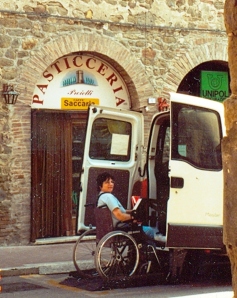
Unloading Robin from the panel truck to buy pastries in Torgiano
A French truck with a 4-speed stick shift was certainly an unusual (and sometimes cumbersome) vehicle for touring Tuscan and Umbrian hill towns, but it served our purposes.
For roughly half the trip, my friend and fellow Banana Slug, Martha Wolf and her sister Susan traveled with us. We met up in Venice and went to Modena and Lucca. After spending a week at an agritourismo near Lake Trasimeno in Umbria, the 4 of us headed for Florence. Driving in Florence is an absolute nightmare – even the Florentines avoid it. At one point, I found myself on an increasingly narrow street and noticed a sign pointing in the opposite direction that I was headed.
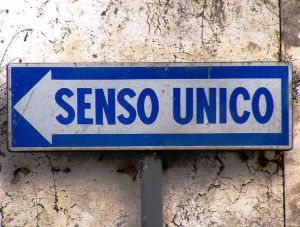
Several locals had to help me back up the panel truck for about 2 blocks – did I mention that it was a cumbersome vehicle? I had a brief meltdown at that point, but I’ll never forget what “Senso Unico” means!
Once we actually got to the Grand Hotel Cavour near the Duomo and let the doorman park the Renault, we had a great time in Florence – wandering the ancient streets, marveling at the art and architecture, and eating magnificent meals.
Two days later, I was looking at a local newspaper and discovered that Bob Dylan would be performing in Florence the following night. Martha and her sister weren’t interested but Robin was eager to go. I talked with the concierge at the hotel about handicap accessibility at the venue. The man did a fantastic job! First, he called the Palasport and found out that I needed to make arrangements at the ticket office. Then, he wrote out a note in Italian, explaining exactly what my situation was.
On the day of the concert we made a midday excursion to the Galleria dell’Accademia to see Michelangelo’s David. Afterwards, we sat down at a café and discovered that we were having lunch next to Huey Lewis (sorry, we were trying not to act like paparazzi, so no picture of him).
That afternoon, while Robin took a nap, I headed off to the central box office near the Santa Maria Novella train station. The vast majority of folks in line were buying tickets for the Dylan concert – it was a gallimaufry of college students and middle-aged fans from all over Europe – not many native English speakers but they all spoke some English.
After about half an hour, I got up to the counter and presented the note from the concierge. The clerk read it, nodded and said “No problem.” He showed me a seating chart and pointed at the far left seat in the 34th row on the floor. Not great but it would do. I nodded back. He then sold me 1 ticket.
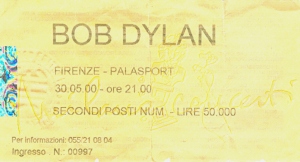
In May 2000, Italy was still on the lira. A 50,000 lira ticket was basically $25.
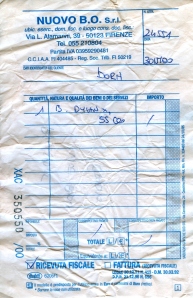
Note that even in Florence, the box office adds a service charge – but only about $2.50.
I was confused. Why only 1 ticket? That question wasn’t in my TravelTalk Italian Phrase Book. “Perché solo un biglietto?” I improvised. The clerk attempted to explain but neither his English nor my Italian were adequate. He spoke to a woman in line. She turned to me and said, “Your wife sit next to you.”
That much I’d already figured out. “Bene.” I smiled. Then I repeated “Perché solo un biglietto?” while raising my index finger in an attempt to emphasize my concern about the “un.”
The woman matter-of-factly replied, “Because your wife bring her own chair.”
I suddenly felt like I was in the middle of a Chico Marx routine. I thanked everyone for their help but left the box office unconvinced that Robin was going to get into the concert.
When I got back to the hotel, I told Robin what had happened. She laughed. “I don’t need to buy a ticket because I’m bringing my own chair. I love it!”
I suggested that Dylan’s management might not be as amused by that logic.
We decided to get to the concert early, in case there were complications. After a light dinner, we had the doorman get us a hatchback taxi. The driver stashed the wheelchair in the back and drove us out towards the venue. As we got neared the arena, what a shock – there was a terrible traffic jam! Eventually, the cab driver dropped us at the edge of the park where the Palasport is located.
I was pushing Robin’s chair when, as we approached the entrance to the arena, I was flagged down by a woman in a day-glo chartreuse jumpsuit. This was not just another rock fan making a fashion statement – she was a member of a local organization called Miseracordia that apparently was responsible for safety and security at public events. She escorted us to an accessible entrance and then lead us right to our seats – actual my seat and the adjoining aisle where Robin would park her chair. She then showed us where the accessible restroom was and said she would come back and check on us after the show started. I was a little puzzled by this last comment, but things had gone pretty smoothly, so I didn’t let it worry me.
I wheeled Robin to the accessible restroom and then walked over to the concession stand. They were serving espresso in short, round paper containers – like what a portion of ketchup might come in. I ordered 3 – hey, they seemed small. The barrista lined them up on the counter and I knocked each of them back in one gulp. I definitely wouldn’t be falling asleep during the show!
Robin and I returned to our seating area and watched the crowd file in. By 9:15 the arena was packed. The lights dimmed and Bob and his band came out – they were perfectly dressed for an appearance at the Grand Ole Opry. Bob has written hundreds of songs but that night he started his set with an old folk tune, Duncan and Brady.2 The crowd went absolutely nuts. I hadn’t seen such rowdy enthusiasm since a Patti Smith concert at the Santa Monica Civic back in May of 1978. And, just like at that show, within seconds everyone was standing on their chairs. Well, not quite everyone: Robin, unable to do that, struggled to find an angle where she could see the stage.
Dylan continued with The Times They Are A’Changin’, Visions of Johanna and To Ramona. Just about the time he sang “Ramona come closer” the Miseracordia woman reappeared with a flashlight. She gestured for us to follow her. She lead us across the floor and down near the right side of the stage. There was a ramp up to a raised platform. 6 or 7 other folks in wheelchairs were sitting there, totally digging the show. We were very close but so far off to the right that we couldn’t see some of the band members. Robin didn’t mind; Dylan’s distinctive profile was quite clear.
There was one song I especially wanted to hear that night: Tangled Up in Blue. It’s a great song but I had a specific reason for wanting to hear Dylan sing it in Florence. Our hotel was a just short walk from Dante’s house – or at least one house where he supposedly had lived. I have the feeling that saying “Dante lived here” is the Italian equivalent of saying “George Washington slept here” on the East Coast of the US. Nevertheless, 2 days earlier we’d gone to see Dante’s house and I recalled the fifth verse of Tangled Up in Blue:
“She lit a burner on the stove and offered me a pipe
‘I thought you’d never say hello,’ she said
‘You look like the silent type.’
Then she opened up a book of poems
And handed it to me
Written by an Italian poet
From the thirteenth century.
And every one of them words rang true
And glowed like burnin’ coal
Pourin’ off of every page
Like it was written in my soul from me to you…
Tangled up in blue.”3
The lit major in me loved that verse: the song’s narrator was seeking his long-lost soul mate in much the same way that Dante had sought a glimpse of his beloved Beatrice. Of course, there’s no record of Dante “workin’ for a while on a fishin’ boat right outside of Delacroix” or Beatrice “workin’ in a topless place.”
Anyway, I’d seen Dylan perform the song several times and heard bootlegs of other live performances and for some reason he tended to skip that verse. But that night, in the city where Dante was born, the next song he played was Tangled Up in Blue and he sang that verse.
Dylan did a total of 19 songs that night4, but TUIB (as Dylan fans refer to it when texting each other) was the highlight for me.
The crowd stayed on their feet for the entire show (except in our section). During It Ain’t Me, Babe I looked back and saw several thousand raised hands with pointing index fingers as they belted out “No, no, no!” l laughed, remembering how I had pointed while trying to speak Italian to the ticket seller. “No, no, no!” – the only Italian words sung all night.
After the show, we waved good-bye to the day-glo green lady and took a cab back to the hotel. I lay awake, thinking about the concert – and wishing I hadn’t had that third espresso.
So… what have we learned?
- Who needs Esperanto? Rock and roll is the universal language.
- When the world gives them lemons, Italians make lemoncello.
It’s great to see and do all sorts of different things in foreign countries, but I also like doing some of the same things I normally do at home. That way I get to see the subtle differences between here and there… like not having to buy a ticket when you go to a Dylan concert in a wheelchair.
Later…
- http://www.nautilustours.com/aboutus.html
- Here’s a sample of what he sounded like:
http://www.bobdylan.com/#/songs/duncan-and-brady - Copyright ©1974 Ram’s Horn Music
- http://www.boblinks.com/053000s.html
Filed under: Bob Dylan, Disabled Travel, Humorous Musings | 11 Comments
Tags: Bob Dylan, Dante, Disabled Travel, Florence, humor, Italy, m. j. dorn, memoir, Michael Dorn, multiple sclerosis, rock and roll, wheelchair
It’s 11:30 and I’m sitting in the Business Center of the Monterey Marriott, feeling guilty about not having posted anything since the 11th of September.
I started a great story about my wife and me going to a rock concert in Italy. That post will appear soon. But, as the cliché goes “shit happens.”
So, until I spin that yarn, here’s a video clip from You Tube to amuse you.
It comes from the movie “International House,” a strange comedy from 1933 with a cast that includes W.C. Fields, George Burns, Bela Lugosi and – for you buffs of real movie esoterica – Franklin Pangborn. The plot, such as it is, revolves around a hotel in the Chinese town of Wu-Hu where a collection of wacky characters are bidding for the rights to new invention… television.
Here’s the best of the programs… sort of MTV from the Harlem Renaissance. Enjoy!
http://www.youtube.com/watch?v=D44pyeEvhcQ
So… what have we learned?
- In the 30s, marijuana was seen as energizing.
Later…
Filed under: Humorous Musings | 2 Comments
Tags: Cab Calloway, comedy, humor, International House, W.C. Fields
I worked in corporate training departments on and off from 1978 to 1996. During that period, I was laid-off 3 times (frankly, the term “downsizing” – which is how my employers described those traumatic events – strikes me as infantile… like saying “spit up” instead of “vomit” or “boo boo” instead of “shotgun blast to the chest”). So, the cliché is “the third time’s charmed,” right? Well, I don’t know if “charmed” would be the first adjective I’d use. But, since that last layoff, I’ve been able to support myself as a freelance writer/instructional designer/training project manager for over 12 years. And, for the last 11 years, the people who’ve lined up most of that work for me have been Cindy and Pat, the two women who founded and own a consulting firm called CPS.
The company has a Yahoo Group to facilitate communication with and among its network of contractors. Regular readers of this blog – and WordPress stats indicate that there are several score of you out there – will be amused to learn that, on August 27th, Cindy and Pat sent out the following message to the members of that Yahoo Group.
Thought we’d get some end-of-summer juices flowing by posting a question that received a lot of action on one of my LinkedIn groups…
What have you learned this year?
As a white male, I didn’t feel I could effectively deliver my ideal response to that question: “Oh no, you did-uhn’t!”
They had either “borrowed” my blog’s tagline… or hadn’t read it.
Oh well, c’est la vie. Having been asked this extremely familiar question, I decided to use it as an opportunity to reflect on my first three months as a blogger. Because, one thing I’ve learned this year is I really enjoy blogging.
Let me explain how I started writing the dorn blog. Very simply, I had no work. I can imagine Cindy and Pat reading this and thinking, “That can be arranged again, Mike.” However, it wasn’t their fault; it was the recession – lots of companies were putting training initiatives on hold. Besides, they had a rather obvious incentive to keep me busy – when I’m working, they’re making money too!
I’d been thinking about writing a blog for a while, but couldn’t figure out what to write about. So, rather than deal with something important or difficult, like my blog’s purpose and content, I decided to come up with a name for it. Somewhere I have a long list of puns on my last name. My wife, Robin, being a huge Springsteen fan, was partial to Dorn in the USA. Not bad, but I thought I might tire of it. Ultimately, one of the very worst of the punning names – That Dorn Blog! – got tweaked to become the name I went with. One thing I learned as an adolescent that continues to be just as true as I prepare to leave middle age: when in doubt, be vague. I liked the dorn blog because it was vague enough that I could write about damned near anything.
Okay… the blog had a name. Now what? I started listing things I wanted to write about… it was all over the map:
- Having the same name as someone slightly famous
- Memories of high school and college
- Stupid work experiences
- Television commercials
- My theory about sarcasm
- Rock music
With the exception of the last subject, I figured I could lump them under the rubric “Humorous musings.” Regarding rock music, I even had a story about my brief career as a record reviewer for Rolling Stone that would fit in that category. Yet again, vagueness demonstrated its utility.
I got an account on WordPress at the end of May and started drafting my first post. Even though I had a general idea of what I was going to say, the discipline of trying to coherently (and humorously) express that idea led to a kind of quantum leap of consciousness – things just popped into my head. I remembered that feeling from decades back, when I wrote fiction – it’s called creativity. Even though my blog is non-fiction, the concept still applies – how you tell the story or convey the idea requires imagination.
As I neared the end of the first post, I was looking for a way to wrap up the story. I was writing about a comedy record that I loved in junior high: Stan Freberg Presents the United States of America. Thinking about junior high reminded me of another humorist I enjoyed back then: James Thurber. He had written a series of short pieces called Fables for Our Times1. In these fables, he took seemingly innocent stories and injected a strong dose of cynicism into them. Like most fables, each of Thurber’s ended with a moral – except that his were essentially the punch lines of the story. For example, here is his take on Little Red Riding Hood – The Little Girl and the Wolf:
One afternoon a big wolf waited in a dark forest for a little girl to come along carrying a basket of food to her grandmother. Finally a little girl did come along and she was carrying a basket of food. “Are you carrying that basket to your grandmother?” asked the wolf. The little girl said yes, she was. So the wolf asked her where her grandmother lived and the little girl told him and he disappeared into the wood.
When the little girl opened the door of her grandmother’s house she saw that there was somebody in bed with a nightcap and nightgown on. She had approached no nearer than twenty-five feet from the bed when she saw that it was not her grandmother but the wolf, for even in a nightcap a wolf does not look any more like your grandmother than the Metro-Goldwyn lion looks like Calvin Coolidge. So the little girl took an automatic out of her basket and shot the wolf dead.
(Moral: It is not so easy to fool little girls nowadays as it used to be.)2
For some reason, I liked the idea of a moral but didn’t want to use that term. The phrase “Lessons Learned” crossed my mind, but sounded too corporate. In the end, I went with: So…what have we learned?
On the afternoon of Tuesday, June 2nd I hit “Publish” and joined the blogosphere. Then, I had that David Byrne moment… from the Talking Heads song Once in a Lifetime:
“And you may ask yourself,
Am I right? …Am I wrong?
And you may tell yourself,
MY GOD! …WHAT HAVE I DONE?”
Every week a new post… like a beast I have to feed. But I do it… and I like it. Who cares? Why bother? Well, it’s pure self-motivation – I care. It’s a form of self-discipline, like going to the gym… but it takes much longer to break a sweat. And so here I am on week 15.
Oh yeah… the readers. Since June, I’ve had over 3,900 separate views! I’ve done a small amount of shameless self-promotion, but most of those readers found my blog on their own. Roughly half of those views were for a single post – the one titled Not Quite “Almost Famous” – that story I mentioned earlier about my very brief career reviewing record albums for Rolling Stone magazine.
So… what have we learned?
- If you want people to read (or at least look at) your blog, include celebrity nudity. It’s true! In my most viewed post, the example is not very titillating – and it is absolutely essential to the story (really!) – but WordPress statistics tell me that most people found it through a search that included the names “John Lennon and Yoko Ono” plus the word “nude.” I’m shocked, shocked I say!
- Clearly, Cindy and Pat have been so busy networking with potential clients that they haven’t had time to read my blog.
Okay, ladies, back to work!
Later…
P.S. I will be introducing a second blog in about 6 weeks – one focused on rock music. It will feature a “song of the week” – including streaming audio of the song plus a short anecdote about why I selected it. Basically, it will allow me to play DJ once a week. Stay tuned for details!
Filed under: Humorous Musings | 3 Comments
Tags: blog, blogging, comedy, creativity, humor, James Thurber, learning, m. j. dorn, Michael Dorn

 the dorn blog